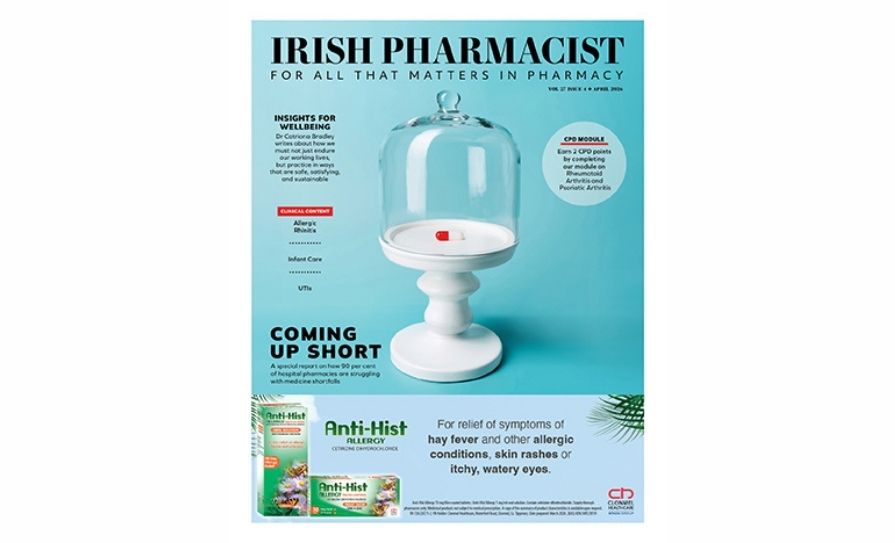
Niamh Cahill reports on how almost 90 per cent of hospital pharmacists are struggling with medicine shortfalls
The overwhelming majority of hospital pharmacists in Europe still experience medicine shortages “which constitute a problem delivering the best care to patients”, according to a newly-published survey.
The finding is contained in the European Association of Hospital Pharmacists (EAHP) 2025 Shortages Survey Report, titled Shortages of Medicines and Medical Devices in the Hospital Sector – Prevalence, Nature and Impact on Patient Care.
The survey, completed by 859 hospital pharmacists, patients and other healthcare professionals from 36 different countries, including Ireland, revealed that 89 per cent of hospital pharmacists are battling medicine shortfalls.
The online survey ran from March to July 2025 and was made available in 17 different languages.
As global medicine shortages show no signs of abating, the findings are of little surprise to those working in the pharmaceutical industry.
Medicine shortages create a burden of between six-to-10 hours on pharmacies per week in Ireland, according to pharmacists.
The Pharmacy Group of the European Union (PGEU) has said that the time spent by pharmacists dealing with medicine shortages has tripled in the last 10 years.
The latest report from the EAHP provides little in the way of good news, as the survey lays bare the daily struggles encountered by hospital pharmacists trying to provide medication and medical devices to patients.
Delays and cancellations
The President of the EAHP, Mr Nenad Milijkovic, points out in the report that there has been a significant increase in respondents citing treatment delays and cancellations of care, 64 per cent and 38 per cent respectively, compared to 2023.
He noted that “through carrying out numerous surveys on medicines and medical device shortages, since 2012, EAHP, together with other stakeholders, managed to raise awareness of the problem and to pave the way for the new European ecosystem to address shortages”.
“This includes the extended mandate of European Medicines Agency (EMA), the EMA shortages monitoring platform, the ongoing processes for the revision of EU’s General Pharmaceutical Legislation and adoption of the
Critical Medicines Act, as well as other announced upcoming proposals, such as the targeted simplification of rules on medical devices and in vitro diagnostics,” he stated.
Yet, despite these efforts medicine shortages remain a significant issue for hospital pharmacists, he argued.
“Problems caused by medicines and medical device shortages remain grim, threatening patient care in hospitals and require urgent action,” Mr Milijkovic warned.
He called for a number of actions to help alleviate the burden caused by medicine shortages, including: “Supporting the European production of active pharmaceutical ingredients, especially when it comes to products with a high dependency on outside sources.”
He also encouraged member States to implement measures that support and increase risk assessment practices in hospitals.
EU countries should also be mandated to “set up national task forces, comprised of national agencies, industries and frontline healthcare professionals like hospital pharmacists to discuss and adopt proactive measures for combatting shortages, including performing joint risk assessments based on timely provided information,” he argued.
Another recommendation proffered was the creation and regular maintenance of safety plans and risk assessment for manufacturers.
Mr Milijkovic added that “safeguarding and facilitating hospital pharmacists’ role in the field of compounding to offer adequate patient care” should also take place.
With regards to the procurement of medicines and medical devices, he suggested that this should be undertaken using a “comprehensive set of criteria, not solely on the price of a medicine or a medical device, adopting a multi-winner approach and consulting representatives of hospital pharmacists and other healthcare professionals when tendering procedures are centralised”.
Hospital pharmacists, he argued, should be facilitated in the field of compounding and greater co-ordination and solidarity between EU member States should be sought to help ensure the involvement of all supply chain actors, including hospital pharmacists and healthcare professionals.
Impact
Some 79 per cent of hospital pharmacists said that medicine shortages “negatively impact the ability of the hospital pharmacy to operate”, the survey found.
Around 74 per cent of those surveyed identified a global shortage of an active pharmaceutical ingredient (API) as the primary cause of medicine shortages. Manufacturing issues was identified by 65 per cent, while medicine pricing, either too low or too high, was said to be the cause by 56 per cent of respondents.
IT systems are not automatically fed with information on ongoing medicine
The impact of shortages on patient care includes delays in care or therapy, 66 per cent reported
shortages and recommended alternatives, 77 per cent of hospital pharmacists reported.
Furthermore, in 2024, “29 per cent of hospital pharmacists experienced shortages more than 20 times for medicines supplied by a single manufacturer and 27 per cent for medicines supplied by a single wholesaler”, the report stated.
The impact of shortages on patient care includes delays in care or therapy, 66 per cent reported; cancellation of care (38 per cent); and suboptimal treatment (37 per cent).
The types of medicines most frequently in short supply, according to hospital pharmacists, were antimicrobial agents (63 per cent), oncology medicines (46 per cent), and anaesthetics agents (32 per cent).
In 2024, all hospital pharmacists experienced the shortage of a critical medicine at least “one-to-three times”, the report found.
Compounding
In the latest survey, questions on compounding were added to help gain a greater understanding of the practice in EU states.
When asked if compounding was allowed in the respondents’ country as a “shortage mitigation pathway”, 61 per cent of hospital pharmacists said it was, 16 per cent indicated it was not, and the remainder responded ‘I don’t know’.
Respondents were asked to list all the medicines compounded, and the highest responses to the questions were sodium chloride or infusion fluids (NaCl, IV solutions), amoxicillin (and co- amoxiclav, antibiotics), midazolam (oral or IV), quetiapine and sertraline, and paracetamol or ibuprofen.
Another question asked: ‘Could you please confirm if compounding is only allowed in your country when there is an existing official compounded preparations monograph?’
Responses to this question varied, with 36 per cent stating they could still compound without an official monograph and 29 per cent stating that they required one.
The remainder indicated that they did not know, suggesting that the practice varies between countries and individuals, the report stated.
Medical device shortages
The survey found that 53 per cent of hospital pharmacists reported that medical device shortages cause problems in delivering the best care possible to patients.
Furthermore, around 45 per cent of those surveyed said that medical device shortages cause problems in the operation of hospital pharmacies.
When asked to outline the primary cause of medical device shortages, 39 per cent of pharmacists cited supply chain problems, while 35 per cent said the shortage or discontinuance of a component, part or accessory of the medical device was the primary issue.
Some 38 per cent of respondents said that low-to-medium risk medical devices, including mainly devices installed within the body for less than 30 days, were among the type of devices most frequently in shortage.
Low risk, non-invasive, everyday devices or appliances were thought to be most frequently in short supply by 32 per cent of hospital pharmacists, while 17 per cent said medium-to-high risk devices were most commonly in short supply.
Around 58 per cent of respondents said medical device shortages caused delays in the care/therapy disease pathway, 43 per cent cited increased length of stay in hospital as a result, and 40 per cent said shortages resulted in the cancellation of care.
Patient views and experiences
The opinions of patients, families and their experiences around medication and medical device shortages were collected in the survey.
“The majority of patients responding to the survey generally did not observe medicines (59 per cent) or medical devices (61 per cent) shortages, though among those who reported having experienced shortages, substitution with an alternative medicine was the most common mitigation measure offered,” the report stated.
One-quarter of patients and/or their family members said the care provided while they were at hospital was impacted by medicine shortages. Around 15 per cent said their care was affected by a medical device shortage.
When a shortage arose, 56 per cent of patients affected indicated that an alternative medicine was offered as a substitute.
When asked what impact the medicine and/or medical device shortage had on their care or that
of their family member, 52 per cent said it resulted in delays in care in the disease pathway, 25 per cent said it resulted in increased monitoring,
21 per cent outlined that it led to adverse events/greater toxicity, and 21 per cent said it caused an increased length of stay in hospital.
Response categories for pharmacy technicians (PTs) and ‘other staff dealing with shortages’
were added
The views of patients and their families starkly outline the very negative effects shortages can have on patients and illustrate the need for much greater efforts to eliminate shortages and prevent patient harm.
Previous analyses were conducted by the EAHP on medicine shortages in 2023 and in 2019. In 2023, 1,497 responses were collected overall and in 2019, some 2,130 responses were collated.
This indicates that the response rate has continued to fall since 2019, but the report does not offer any reasons as to why the response rate has more than halved since 2019.
In the latest report, response categories for pharmacy technicians (PTs) and “other staff dealing with shortages” were added.
Future
The report states that the information collected “indicates that shortages remain a persistent and widespread challenge across Europe,” which suggests that the problem is not expected to ease greatly in the near future.
The report from the EAHP helps to monitor the impact of shortages across Europe and provides useful information for those working in hospital pharmacy to help reduce the impact of shortages on patients. It also highlights that there is much room for improvement in the area.
“Findings from the 2025 survey confirm that shortages of medicines and medical devices persisted throughout 2024, with continued impacts on patient care and hospital pharmacies’ activities. Despite improved awareness of critical medicines, uncertainty remains around alignment with EU-level lists, and reliance on national information sources is increasing.”
Furthermore, the report outlines that while further investigation is needed, the report appears to show that “statistical correlations appear to emerge between the severity, the frequency and the number of classes of critical medicines and medical devices affected by shortages”.