
The PIER strategic plan sets out a course of action to support all pharmacists, including those outside of the community and hospital settings
Introduction
Pharmacists in Industry, Education and Regulatory (PIER) is a voluntary, member-driven organisation established in November 2012. Its mission is to represent and support pharmacists working in non-traditional roles; most frequently within industry, academia, and regulatory sectors. PIER provides
a forum for professional development, networking, and advocacy, serving as a trusted partner to stakeholders such as the Pharmaceutical Society of Ireland (PSI) and higher education institutions.
In November 2025, PIER launched its strategic plan for 2026 to 2030, titled ‘Evolving Together for Impact’, setting out the organisation’s goals and aspirations to continue to add value and play a vital role in pharmacy across all settings.
Genesis of PIER
PIER was formed during a period of significant transformation in the pharmacy profession. The Pharmacy Act 2007 introduced mandatory Continuing Professional Development (CPD), and the Pharmacy Education and Accreditation Reviews (PEARs) report led to the new five-year integrated MPharm programme, emphasising experiential learning.
At the time, awareness of career paths outside community and hospital pharmacy had declined, and few new graduates considered roles outside of traditional settings. PIER emerged to advocate, provide networking opportunities, and ensure that all pharmacist voices regardless of professional setting were heard by regulatory bodies, educational institutions and other relevant stakeholders.
Achievements in the first 10 years
Over its first decade, PIER grew into a vibrant organisation with over 200 active members, including students and professionals across academia, industry, and regulatory sectors.
PIER has radically transformed how industry, education, and regulatory roles are perceived. It organises annual career development evenings, continuing education seminars, and networking events. Mentorship programmes have supported numerous mentors and mentees. The organisation has also contributed to shaping pharmacy education, facilitating internships, and raising the profile of pharmacists in non-traditional roles.
Key milestones achieved over the first 10 years included:
- 2012–2015: Establishment and advocacy for CPD frameworks.
- 2016–2020: Expansion of educational offerings, career bootcamps, and networking events.
- 2021–2022: Increased reliance on online and virtual events, formalisation of mentorship programme.
Motivation for a new strategy
As PIER passed its 10th anniversary, the committee reflected on its founding goals and assessed ongoing relevance. The pharmacy sector has continued to evolve, with increased interest in industry and regulatory careers following the successful roll-out of the five-year MPharm programme. Feedback from members revealed that while PIER was widely valued in principle, in practice, the specific benefits to individual members varied. Some felt well served, while others saw limited personal value.
This prompted the development and launch of the 2026 to 2030 Strategy to ensure PIER continues to meet the needs of its diverse membership into the future. Under the leadership of Stan O’Neill and David O’Grady as Chairs and co-ordinated by Strategy Lead Rosemarie Tully, the recently-launched strategy was developed over two years through surveys, interviews and workshops.
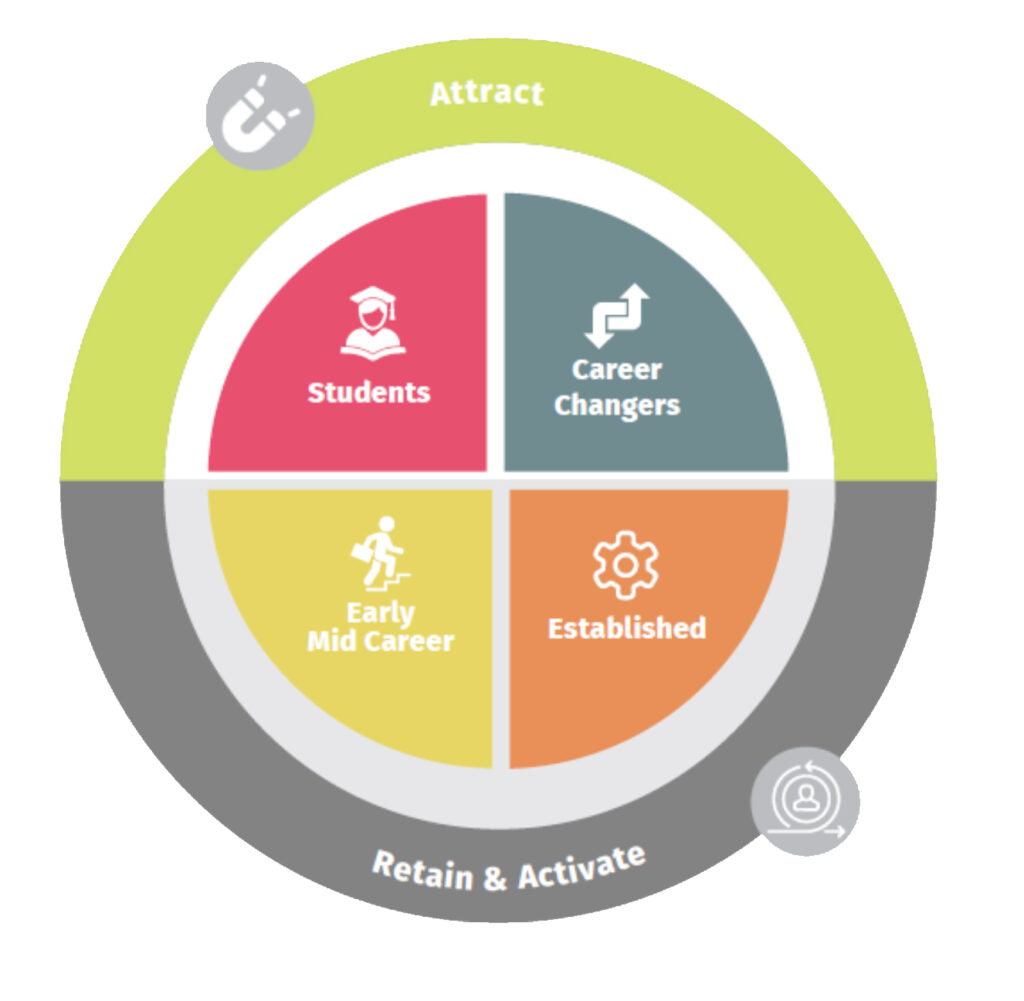
PIER serves members from a range of sectors in a variety of roles united by their common undergraduate training in pharmacy. Members can be segmented into four segments:
1 Students.
2 Career changers.
3 Mid-career pharmacists.
4 Established professionals.
Segments 1 and 2, students and career changers, are PIER’s main source of new members, and can be targeted effectively by continuing to serve their needs, primarily through information sharing, career seminars, mentorship and introductions.
Segments 3 and 4, mid-career and established professionals, have different needs and interests. PIER relies heavily on these segments to provide the information and mentorship that is of interest to the students and career changers. To retain and activate these important segments, PIER must do more than request support, and so in the 2026 to 2030 Strategy, PIER plans to introduce new offerings that are more relevant and will seek to create closed sessions where members can share their experiences and challenges in an environment governed by Chatham House rules. Regular evaluations
and member engagement will inform ongoing evolution.
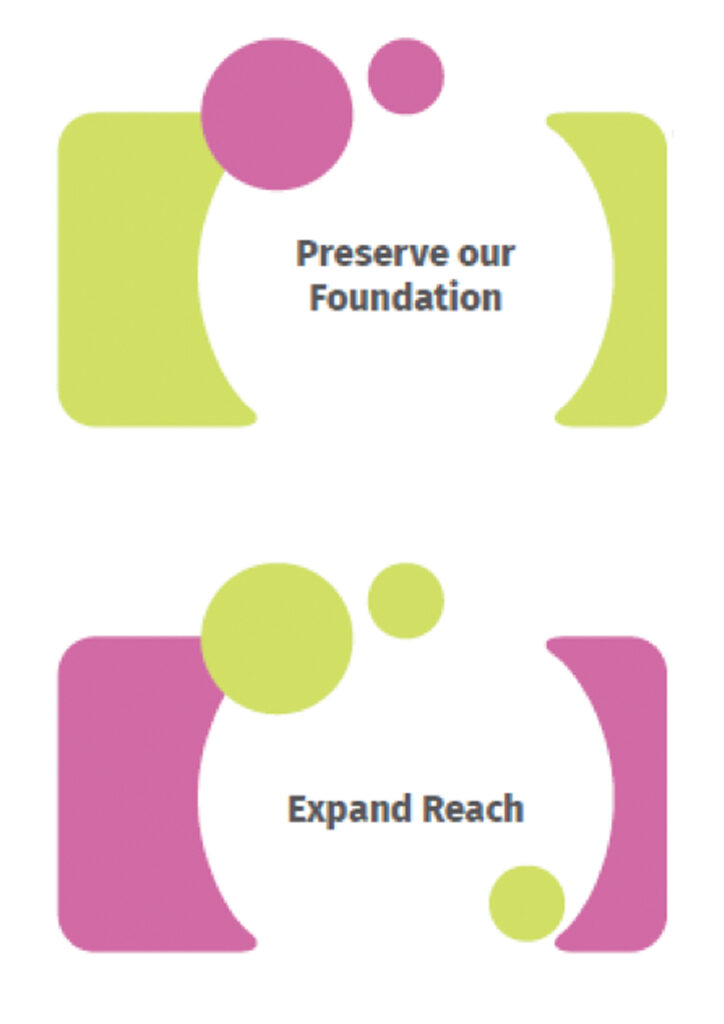
SERVE MEMBERSHIP NEEDS PIER is supported by current and lapsed members, who value advocacy with PSI, IIOP and other stakeholders, as well as access to information, networking
nd mentoring opportunities
ATTRACT NEW MEMBERS Students, new graduates and career changers are the source of new members; benefiting from career and mentoring events
ACTIVATE EXISTING MEMBERS PIER needs to step up to activate and better serve more experienced members
The goal is therefore to continue to do what PIER knows members value and use, ie, preserve our foundation, whilst also expanding and building on that foundation to attract new members and reactivate existing and lapsed members by providing them with the content and services that are relevant to them, ie, expand reach.
The strategy is built around three core action areas:
1. Do what we do better
- Upgrade digital platforms and communication tools.
- Strengthen committee engagement and governance.
- Enhance existing offerings for members.
2. Introduce new offerings
- Expand educational resources and Special Interest Groups (SIGs).
- Launch subcommittees for specialised areas.
- Foster active two-way engagement through digital channels and networking events.
3. Celebrate success
- Establish recognition awards for outstanding contributions.
- Host flagship events every two years to showcase achievements.
- Broaden visibility through proactive outreach.
Defining success
The impact of PIER since its foundation is clear; the number of pharmacists in settings outside of community and hospital has grown. Undergraduate students regularly consider industry as a career path from their first year and undertake internships in PIER settings as part of the integrated MPharm. As PIER evolves, the measures of success must also evolve and become more ambitious. Rather than focusing on the downstream effects of PIER’s work, PIER will routinely and directly measure the success of the organisation and activities by monitoring and reporting on:
- Membership growth and retention.
- Increased participation in events and Special Interest Groups (SIGs).
- Enhanced visibility of PIER in industry and education sectors.
- Regular publication of performance metrics and impact reports.

PSI: Pharmaceutical Society of Ireland, IIOP: Irish Institute of Pharmacy, EIPG: European Industrial Pharmacists Group, FIP: International Pharmaceutical Federation
Figure 3: PIER activities
The engine behind PIER’s success
PIER is reliant on a committee made up exclusively of volunteers. Members pay an annual fee which supports necessary expenditure, such as website maintenance and general administration. Most events benefit from the generous voluntary and free of charge contributions of speakers, mentors
and academic partners who often host activities free of charge on site.
PIER is deeply grateful to committee members, past and present, for their dedication over the years. The founding committee members established the systems and structures upon which subsequent committees have relied. This committee was led by Stan O’Neill as Chair, supported by Orlaith Brennan, Jack Daly, Brendan Griffin, Maura Kinahan, Muireann McAlister, Catherine McHugh, Mary Rafter, and Rosemarie Tully.
Maura Kinahan deserves special recognition, having been the spark that ignited PIER and has served on every committee since its establishment. Her passion for developing young pharmacists and shepherding them through to successful careers in their chosen setting is remarkable.
The current committee was elected at the 2025 AGM. David O’Grady continues as Chair, Patience Wobuoma is Secretary, Stan O’Neill is Treasurer, supported by Blanaid O’Connell, Maura Kinahan, Aifric Heffernan, Barry Heelan, Dearbhla Walsh, and Aisling Ewulonu.
Conclusion
PIER is excited to present the 2026-2030 Strategy. We hope that this will build on the widespread consensus of PIER’s value to the Irish pharmacy ecosystem. The strategy represents our commitment to evolve our offerings, engagement tactics to strengthen our position as a dynamic, member-driven organisation ready to adapt and lead in a changing professional landscape. By focusing on excellence, innovation, and recognition, PIER aims to strengthen its role as a vital resource for all pharmacists, regardless of setting.
If you are interested in learning more about PIER membership or volunteer opportunities, please visit PIER.ie or contact membership@pier.ie.

Aifric Heffernan is a pharmacist who has held various roles across hospital, community and industry since gradating from RCSI and currently works as Quality Assurance Manager with Sanofi Waterford. She holds the position of communications on the PIER committee.

David O’Grady is a Trinity College Dublin– qualified pharmacist (1991) who has held senior technical roles across the biopharmaceutical industry. He currently leads data science and digital transformation initiatives at Sanofi, practises in community pharmacy, and serves as PIER Chairperson.

Maura Kinahan has extensive experience across development, regulatory affairs, supply chain, commercial operations and medical affairs at leading global companies including Élan, Bristol- Myers Squibb and Pfizer. She holds a pharmacy degree from the University of Strathclyde and a Ph.D. from the University of Manchester, and is also a BioInnovate Ireland fellow. A founding member of Pharmacists in Industry, Education and Regulatory (PIER), Maura leads on career development and mentorship activities.

Rosemarie Tully has spent more than 25 years in the global pharmaceutical industry in various roles across business development, strategy, operations and general management, including time in management consulting and medical devices sectors. Rosemarie is a member of the Pharmaceutical Society of Ireland, completing her pharmacy degree in Trinity College Dublin and an MBA in INSEAD, France. A founding member of Pharmacists in Industry, Education and Regulatory (PIER), Rosemarie coordinated the strategic review and strategy development.