Ciara Long MPSI writes about one of the most important conversations in Irish pharmacy in years

Let me set the scene. It’s a Tuesday evening in late June. Outside, Cork is inexplicably warm – the kind of warm that makes you wonder if you accidentally moved to Portugal. Inside, I’m on a webinar about antimicrobial resistance. And somewhere between the One Health frameworks and the EU joint action plans, it hits me: This was actually one of the most important conversations Irish pharmacy has had in years. Not because the slides are pretty — though they are — but because what was discussed that evening sits right at the heart of what we do every single day.
The webinar in question was the IIOP’s One Health and AMR session on 24 June 2026, featuring Professor Dearbháile Morris from University of Galway,
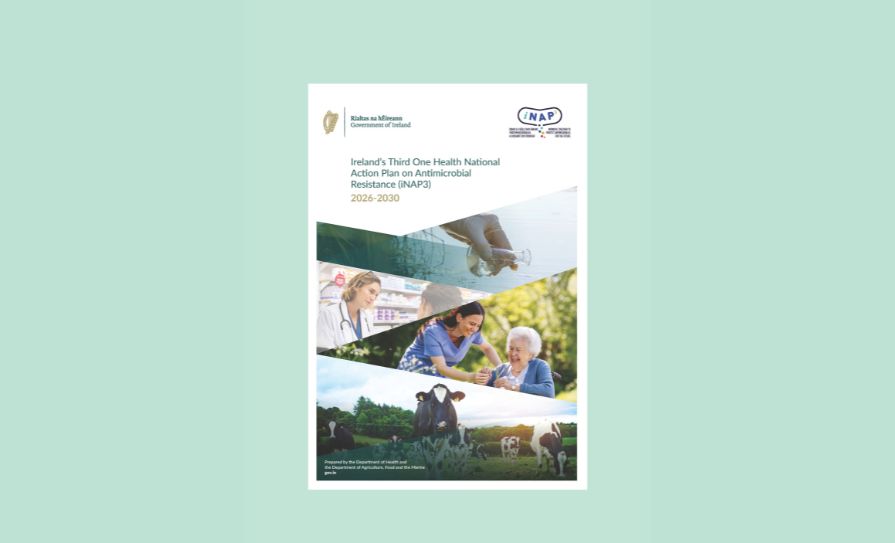
Marie Philbin, HSE Chief Pharmacist for Antimicrobial Resistance and Infection Control, alongside veterinary and GP colleagues. The topic was iNAP3 — Ireland’s third One Health National Action Plan on Antimicrobial Resistance 2026- 2030. And whether you knew about it or not going in, by the end of it you absolutely should.
So what exactly is iNAP3?
In short: It is Ireland’s most ambitious plan yet to tackle antimicrobial resistance, built on the principle — explained beautifully by Professor Morris — that human health, animal health, and environmental health are completely interlinked. One Health is not a new idea; Morris traced it back to Hippocrates. But Ireland’s formal response to it, through three successive national action plans since 2017, represents a serious and sustained commitment that the pharmacy profession needs to understand and own.
Hippocrates, it turns out, was ahead of all of us. In his treatise On Air, Waters and Places, he identified the interdependence of public health and a clean environment — a One Health framework two and a half millennia before the term existed. It is a reminder that the principles underpinning iNAP3 are not bureaucratic inventions. They reflect something fundamental about how health actually works.
iNAP3 sets out six strategic objectives covering awareness, surveillance, infection prevention, antimicrobial stewardship, research, and — new for this iteration — multi-sectoral governance and accountability. The headline target that should make every community pharmacist sit up straight: Reduce antibiotic consumption in Ireland by 27 per cent by 2030. Marie Philbin was clear that recent data is showing encouraging downward trends. She was equally clear that we have a long way to go. And here is the number that puts that into context: 90 per cent of antibiotic use in human health in Ireland happens in the community. Not in hospitals. Out here, with us.
The CCS elephant in the room
Here is the part of the iNAP3 story that I do not think has been discussed loudly enough yet in professional circles. At the exact moment Ireland publishes its most ambitious antimicrobial stewardship plan, Irish pharmacists are gaining independent prescribing authority for common infections under the Common Conditions Service.
That is either a remarkable opportunity or a significant risk. Probably both.
Think about what happens when a patient comes to a pharmacist prescriber with a suspected UTI or a chesty cough. The first and most important clinical question is not which antibiotic — it is whether an antibiotic is needed at all. That decision, made thousands of times a day across Irish pharmacies, is an AMR stewardship decision. Every single time.
Marie Philbin addressed this directly at the webinar and was reassuring: AMRIC has worked hard with all key stakeholders to ensure stewardship principles are embedded in the CCS education and training, clinical protocols, and monitoring from the outset. The agent, dose, and duration in the CCS protocols have been designed with stewardship already built in. That is genuinely good news.
But she also made a point that stuck with me: If you think a patient may need an antibiotic, be careful not to set that expectation in advance of your clinical assessment — because doing so creates a demand that is very difficult to walk back. That is not just a consultation skill. That is a stewardship intervention, and it requires real clinical confidence, not just protocol compliance.
Defending Irish practice — and raising the bar
One of the things I raised during the webinar was whether a formal national audit mechanism is planned for antibiotic prescribing decisions made by pharmacist prescribers under the CCS — essentially, how will pharmacist prescribing feed into Ireland’s iNAP3 targets?
The response from AMRIC was significant: AMRIC has contributed to the plans for assessing the CCS and looks forward to further engagement with the Department of Health on that assessment. That is a welcome confirmation. The question is on the agenda. The detail of how pharmacist-initiated prescribing data will be captured, reported, and used to inform national AMR surveillance is the work now to be done — and the profession needs to be active in shaping it.
Are we doing enough? A fair challenge
The webinar also threw up a moment that generated some lively discussion in the chat, which is my favourite kind of webinar. A colleague with 15 years of community pharmacy experience in Portugal observed that consistent patient counselling on antibiotic course completion and correct dosing intervals is mandatory for both pharmacists and doctors in Portugal, and asked why this seems less consistent in Ireland.
Speaking as someone who has stood on both sides of that counter, I pushed back on what I felt was an unfair characterisation of Irish practice. And to be fair, the evidence supports that pushback. Antibioticprescribing.ie is a genuinely excellent resource. The HSE AMRIC communications programme — targeted social media campaigns, the Ask the Expert series, microlearning videos specifically designed for community pharmacists — represents sustained, evidence-based public health messaging. Dr Edel Doorley, GP and AMR Advisor on the panel, put it well: Patients may not absorb the message the first time they hear it from a GP, but they might the second time they hear it from a pharmacist. One Health, as Professor Morris described it, is a team sport.
But — and here is where I think the Portuguese colleague has a point worth sitting with — iNAP3’s 27 per cent target cannot be achieved on goodwill alone. Consistent stewardship counselling needs to be a professional norm, not something that happens on good days. The resources are there. The question is whether we are using them every time.
What this looks like in practice
My own engagement with iNAP3’s objectives spans three levels. I raise this not to be self-referential, but because
it illustrates what is now possible for pharmacists who move across care settings; there are more of us doing that than the system sometimes recognises.
In the hospital, I contribute to inpatient antimicrobial prescribing audits alongside our antimicrobial specialist pharmacists. Marie Philbin shared a striking statistic at the webinar: A targeted point prevalence survey across nearly all acute hospitals in Ireland in 2025 found that almost 20 per cent of IV antimicrobials could be stopped entirely when reviewed — not switched to oral, stopped. That is a remarkable finding, and hospital pharmacists are well placed to drive that intervention.
Through PAMS-Net, I am connected to the community stewardship network that iNAP3 is actively expanding. With almost 400 members and a format designed around real workload constraints, it is one of the most practical CPD investments you can make right now.
And through the CCS, I am — like many of you — about to become a prescriber of the very medicines that iNAP3 is asking us to use more judiciously. That is not a conflict. It is a responsibility.
A call to the profession
Hippocrates wrote that the greatest obligation of a physician is to do no harm. We might reasonably extend that principle to the medicines we prescribe and dispense: The obligation is not just to treat the patient in front of us, but to preserve the treatments that the patients who come after us will need. That is what antimicrobial stewardship means at its most fundamental level — and it is what iNAP3 is asking every one of us to commit to.
iNAP3 is not a document for policy- makers to read and file. It is the national framework within which every antibiotic- related decision we make as pharmacists now sits — whether that is counselling a patient on course completion, querying a prescription duration, participating in a PAMS-Net discussion, or making our own prescribing decision under the CCS.
Marie Philbin ended her presentation with a simple ask: Identify one action in your setting where you can help promote better antibiotic use. It is a good ask. Mine is this: When the CCS audit framework is being designed, make sure the profession is at the table. Because pharmacist prescribing data that does not feed into national AMR surveillance is a missed opportunity — and in the race to 27 per cent by 2030, we cannot afford those.
Ciara Long (formerly Ní Faoláin) is a Senior Pharmacist at Bon Secours Hospital Cork and a member of the PSI Pharmacist Panel. She is completing the Common Conditions Service prescribing training through the IIOP and participates in PAMS-Net, the pharmacist antimicrobial stewardship network operating under HSE AMRIC. She has previously lectured at UCC’s School of Pharmacy and has written for the IPU Review on pharmacist- led clinical services and AMR stewardship.