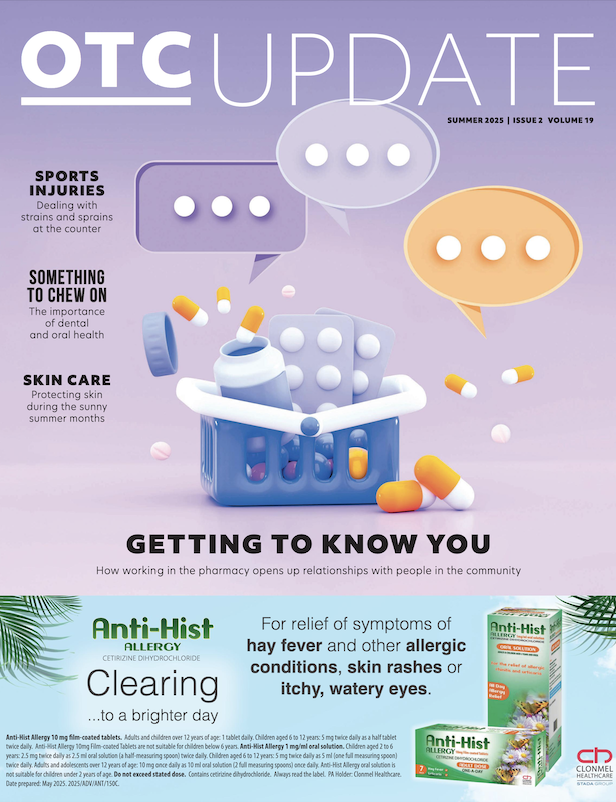
Welcome to your April issue, which you will find packed with thought-provoking content and clinical updates.
Among the highlights in this edition, Dr Catriona Bradley reflects on the content of her presentation at a recent pharmacy event at South Eastern Technical University, where she spoke about wellbeing, self-care and resilience.
Also in this issue, Terry Maguire recounts his experiences with patients who begin with politeness and respect at the counter, but turn hostile when they don’t get what they want, no matter how ill-advised that product might be. Interestingly, data reported in The Pharmacist magazine showed that the majority of pharmacists in the UK experienced aggression due to medicine shortages. Chief Executive of
the National Pharmacy Association Mark Lyonette pointed out that pharmacists and their teams are “face-to-face with patients at the sharp end of any problems with medicines shortages” and “wrongly get blamed for problems further up the supply chain”. Sound familiar?
Dr Des Corrigan casts his judicious eye over a safety update on CBD products, and Fintan Moore talks about efforts to make the pharmacy a welcoming and comfortable place for people with autism.
Part of the pharmacist’s role in this regard is to learn more about effective communication with autistic people. It’s one of those situations where the pharmacist must be a versatile communicator, and a paper from 2024 (Can Pharm J) is well worth a read in this regard. “Communication barriers are related to difficulties of autistic patients in understanding non-verbal or figurative language and difficulties in dealing with environmental distractions,” the authors wrote. “As ASD can differ in clinical presentation, the pharmacist needs to adapt their communication to the patient’s symptoms, severity and individual preferences and include the caregiver if needed.” Fintan also offers some insightful tips that will help to make the process a little easier and more effective for all concerned.
You can earn 2 CPD points with our module on rheumatoid arthritis and psoriatic arthritis, and we also feature content on hay fever, infant care, and UTIs.
All-in-all, a busy issue that we hope will inform and entertain.
Pat Kelly, pat@greenx.ie