Technical knowledge alone does not guarantee effective patient care or team collaboration, write Dr Catriona Bradley and Dr Mary Collins
As I write, December gaiety is well underway, with parties, gift-buying, late-night shopping, planning for family gatherings, and scrambling to finish projects before year-end. As you read, Christmas is probably over and you are already in (or on the verge of) the new year of 2026. It feels a bit weird for me — writing to readers who are on the other side of Christmas. As I hold you in mind, my prevailing curiosity for each and every reader is: How are you?
A new year
The start of a new year can bring mixed emotions for people. It’s a natural time for reflecting on all that has happened in the past year; the good and the bad, the celebrations and the grief, the achievements and disappointments. Some have lost loved ones in 2025, some have gained loved ones, and some have both lost and gained. It can be difficult to untangle the various emotions and it is a natural reaction to avoid doing so. It can be an effective, if short-term, defense mechanism to just soldier on and avoid our emotions. It’s particularly easy to lose connection with ourselves over the Christmas period, when routines are broken, social expectations are rampant, energy levels are flagging, and family/social relationships are often only preserved by not expressing your true feelings! Therefore, the post-Christmas lull, and the movement into a new year, often provides important reflection space to think about all that has happened and how that has affects us. Thus, my question: How are you?
I don’t pose this as an ephemeral, passing, shallow question, such as used in day-to-day interpersonal greetings and interactions (which you’ve probably glibly answered a thousand times over the holiday season). I’m not expecting an answer (although, I do love when readers contact me to share their thoughts, so feel free to answer, if you wish). Rather, I intend it as a sincere, important and deep question, as a prompt to promote reflection. No-one else can know the constellation of thoughts, feelings, behaviours, beliefs, values, relationships, fears and dreams that are encapsulated in you. Nor can they know how you experience and react to life’s events. How you are (taken at its deepest interpretation) impacts massively on how you show up in the world, and that impacts on everything that you do. There is no more important question than: How am I?
Why is such self-knowledge so important?
Self-knowledge, often referred to as self-awareness, is necessary for managing our own emotions (emotional regulation), achieving goals (motivation), understanding and sharing the feelings
of others (empathy) and managing relationships and building networks (social skills). In summary, it is a fundamental component of Emotional Intelligence. Daniel Goleman, widely regarded as the ‘Father of Emotional Intelligence’, describes how crucial emotional intelligence is for our personal and professional growth and development:
“If your emotional abilities aren’t in hand, if you don’t have self-awareness, if you are not able to manage your distressing emotions, if you can’t have empathy and have effective relationships, then no matter how smart you are, you are not going to get very far.” (Goleman, 2006)
I don’t agree entirely with Goleman’s assertion that you are not going to get very far without Emotional Intelligence.
In the world of pharmacy, where intelligence is generally high, I have encountered people with somewhat limited emotional intelligence being quite successful in their work and going quite far, based on the usual social indicators of success. However, I generally don’t enjoy interactions with people lacking in emotional intelligence, and find myself having to make more allowances than is reasonable, to preserve the relationship. For the most part, I tend to favour investing my time and effort to those who have some level of self-awareness and who can engage in a more collegial way.
Those with high emotional intelligence are effective communicators, have appropriate emotional regulation, and enjoy high levels of authenticity and resilience. I prefer to spend time with those people. High levels of emotional intelligence lead to better communication, stronger mental health, enhanced performance and improved personal and professional relationships. It is repeatedly identified as a crucial skill for future workforces, particularly at the intersection of artificial intelligence and emotional intelligence.
“True leadership in an AI-driven world hinges on a delicate balance: Leveraging AI’s computational power while preserving the empathy and ethical insight that define human intelligence.” (escp.eu)
Despite its importance in everything we do, most of us were never taught the skills and behaviours required for true self-awareness, or the wider concept of Emotional Intelligence. As a member
of Generation X (born 1965–1980), the focus of my primary, secondary and pharmacy education was entirely on the acquisition of knowledge, some development of critical appraisal and writing skills, and successful completion of examinations. Subsequent generations of Irish students may have developed skills of self-awareness through subjects such as Social, Personal and Health Education (SPHE), but I’m guessing the capacity to teach such skills to large classes of secondary school students is limited. It is likely our current levels of self-awareness and emotional intelligence are largely influenced by our early experiences and our family environments, which is always a bit of a lottery. The good news is that, unlike traditional intelligence (IQ), emotional intelligence can be developed and cultivated, through skill development. This represents a worthwhile investment of time and effort on a personal level,
as well as being an important factor in developing the capacity of a workforce to adapt to evolving environments.
Given my interest, I was delighted to
It is repeatedly identified as a crucial skill for future workforces
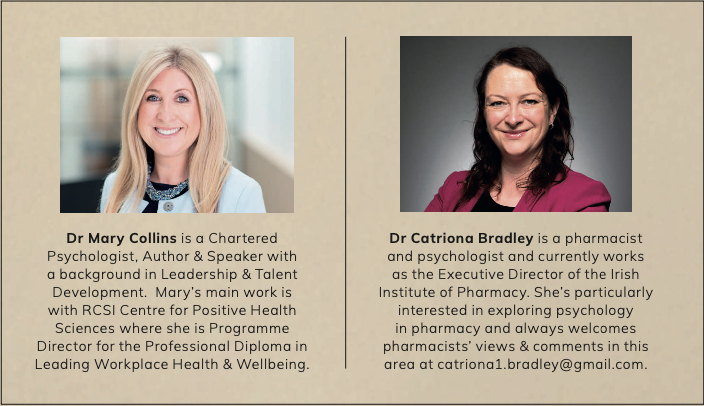
see this issue being addressed by Dr Mary Collins, who works as a coaching psychologist based in the Centre for Positive Health Sciences in RCSI. Mary recently published a book on Emotional Intelligence in Dentistry, basing the content on the findings of an Emotional Intelligence study among dentists. I know how much pharmacists like facts and evidence, so I asked her to contribute to this column through the following Questions and Answers. As we’ve discussed her work, we have agreed that similar work would be valuable in pharmacy, and we’re currently planning to repeat the study amongst Irish pharmacists. Make sure to keep an eye out for our work, early in the new year, which I think you will find most useful. It will certainly provide interesting insights for those interested in answering that all- important question with authenticity and insight: How are you?
1. What is EQ?
Emotional Intelligence (EQ) is the ability to recognise, understand, and manage one’s own emotions, as well as understand and influence the emotions of others (Goleman, 1998; Newman, 2019). The Emotional Capital Report (ECR) by RocheMartin is one measure of EQ that we use across our academic programmes; it defines EQ as comprising 10 core competencies — such as self-awareness, self-control, empathy, optimism, and relationship skills — that form the foundation of emotional capital, a vital asset for leadership success in healthcare.
2. Why is it important?
EQ is essential in pharmacy because technical knowledge alone does not guarantee effective patient care or team collaboration. Emotional intelligence improves communication, builds trust, and strengthens resilience in high- pressure environments. Research by Goleman (1998) shows that EQ is twice as important as IQ for workplace success, and Dr Martyn Newman emphasises that “technical skills get you in the door, but emotional intelligence determines how far you go”.
3. Are some people just naturally good at it?
Are we just talking about charisma? Or is there more to it? EQ is not synonymous with charisma. While certain individuals may have a natural aptitude for emotional perception, EQ involves deliberate development of competencies such as emotional self-control, adaptability, empathy, and resilience. As Dr Martyn Newman shares, “emotional intelligence is not about being nice — it’s about being smart with feelings”. These are learnable skills, not just inborn traits or personality-driven charm.
4. Can it be developed? And if so, how?
EQ can indeed be developed, in fact it is far easier to develop EQ than traditional IQ! The aforementioned Emotional Capital Report provides a structured assessment of emotional strengths and gaps, followed by tailored coaching strategies. Improvements in EQ are achieved through reflective practices, targeted coaching, and real-world application. Neuroscientific evidence demonstrates that emotional competencies can be strengthened over time via neuroplasticity when we are focused and intentional about development of positive habits related to key areas of emotional intelligence.
5. What are the risks of not developing good EQ?
Without well-developed EQ, professionals risk miscommunication, increased stress, diminished patient satisfaction, and burnout. In pharmacy settings, this can translate into workplace inefficiencies, strained team dynamics, and compromised patient safety. Poor EQ also leads to lower levels of motivation in all aspects of life.
6. You’ve recently published a book, EQ for Dentists, based on your study. What did you find?
Our research with NHS dentists revealed that although technical competence is important, high EQ correlates more strongly with resilience, effective patient relationships, and leadership quality. Dentists with stronger emotional intelligence showed greater capacity to manage stress, engage patients empathetically, and guide their teams. The book outlines five key areas of EQ that dentists were consistently scoring lower in. The book is a practical guide to develop in these five years to support dental professionals from training, right through to retirement from the profession.
7. You’ve worked with pharmacists a bit through IIOP and supported some of our early resilience work. Do you have any observations/comments about EQ of pharmacists?
Pharmacists typically exhibit high levels of conscientiousness and empathy, which are core EQ traits. However, challenges often arise in stress tolerance and maintaining optimism in high-pressure environments. Building self-awareness, resilience and emotional agility are critical skills for pharmacists in the increasingly demanding and challenging environment the profession works in.
8. What should people do if they want to find out more?
To explore and enhance emotional intelligence, individuals should: Complete the RocheMartin Emotional Capital Report for a detailed EQ profile; read Dr Martyn Newman’s Emotional Capitalists for practical strategies; and review my book EQ and Dentistry, which provides useful parallels for pharmacy.
References
1. Goleman, D. (1998). Working with emotional intelligence. Bantam Books.
2. Newman, M. L. (2019). Emotional intelligence is not about being nice—it’s about being smart with feelings [Interview]. Speakers Connect.
3. Speakers Connect. (2019). Dr Martyn Newman: Emotional Capitalists – Leaders of Innovation. Re- trieved from https://www.speakersconnect.com/ dr-martyn-newman-emotional-capitalists-lead- ers-of-innovation/