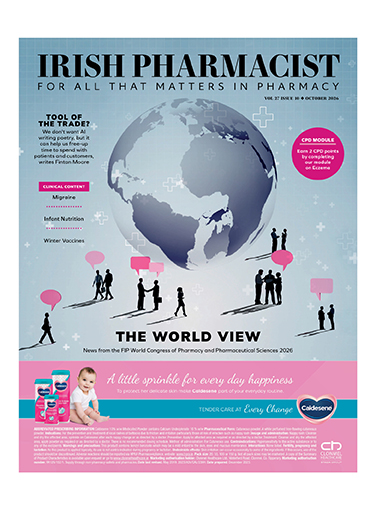
Welcome to your October issue. We hope it will provide something to lift your spirits as the dark evenings close in.
As well as your usual line-up of distinguished columnists and clinical authors, in this issue we feature an article on the effects of the mini-heatwave we suffered – or enjoyed – during summer. If we get the same type of weather next summer, there may be lessons to be learned in terms of patient and medication safety.
Two articles in our News section also highlight gaps in care when it comes to men’s health. For the longest time, women’s health was shamefully neglected. Thankfully, this trend is in reverse and women’s health is finally being prioritised and given the recognition it deserves, although there is still much to be done in that specialised area of healthcare.
A review by the Health Research Board (HRB) from September 2025 found that there are still significant gaps in women’s health in the areas of clinical care, research priorities, and access to care, among others. A work in progress for sure.
However, there is a danger that men’s health might now be overlooked in some aspects of care. Last month, Movember Ireland called on Government to commit €10 million over the next two Budget cycles to fund the National Men’s Health Action Plan. You are probably familiar with the figures – two-in-five men die prematurely before the age of 75, and men account for almost four-in-five deaths by suicide.
There is one area where women’s health and men’s health overlap – the cost of inaction is greater than the cost of action. Poor men’s health is costing the state an estimated €1 billion per annum, 70 per cent of which is potentially preventable.
An interesting new piece of research also highlights the psychological vulnerabilities of the modern man, particularly in the throes of our current obesity epidemic.
Nationally representative research involving 1,563 adults showed that almost three-in-four men (74 per cent) say they would be willing to speak to their GP about losing weight, yet just over one-in-four (27 per cent) have actually done so.
Shame is clearly preventing these men from seeking help, and once again, there is a pivotal role to be played by pharmacists in guiding these men towards the help they need.
Also in this issue, we report on the highlights of the recent FIP 84th FIP World Congress of Pharmacy and Pharmaceutical Sciences. This event highlights the advances in pharmacy in terms of clinical responsibility, medicines optimisation, credentialling, prescribing, and more.
Each pharmacy conference, regardless of he organiser, reminds us of the progress that has been made in recent years, and the developments in pharmacy yet to come.
As the evenings get darker, one ray of sunshine is the bright future ahead for pharmacy.