Terry Maguire takes a much-needed break from the dispensing bench to seek out history in the North West and some family memories
The Todd’s Den
Even after 60 years, it was not difficult to find. The house at the bottom of the lane had been replaced by a modern bungalow, but this was certainly the lane; overgrown and now, 100 meters in from the road, blocked by a farm-gate. We parked in front of the gate and crossing it, we started walking.
My son, having aligned a recent interest in Irish mythology and a story I told him of a great aunt who owned a Giant’s Grave, persuaded me to take a day away from the dispensing bench and bring him to Mary Gallagher’s farm near Castlederg, Co Tyrone, a place I visited frequently as a child. My father lived with his aunt and her family during the summers following his mother’s death when he was four. This was the only mother he really knew and although unspoken, I understood that.
Pink Disease
In the 1960s, when I suffered from a severe and persistent skin rash, Great Aunt Mary was called upon for help. Diagnosed as ringworm by an indifferent GP who prescribed numerous creams, each as ineffective as the next, my father recalled an ointment remedy his aunt has used for all skin rashes. Dutifully, she obtained the ointment from a ‘Seventh Son of a Seventh Son’ faith- healer who lived locally to the Todd’s Den and who had, she told me in hushed tones, prepared this potion with “special skill and great knowledge”. Normally, it would be necessary for the faith-healer to see the patient, but as she knew him, he made an exception. The ointment came in a small aluminium tube and was rapidly effective, so little was needed. It remained in our medicine cupboard for years in case needed again.
Many years later, during my pharmacy course at QUB, the Head of School, Prof Pat D’Arcy, in a lecture on toxicology, bragged that he had identified the source of an outbreak of mercury poisoning (Pink Disease) in the Castlederg area. He traced it to a local faith-healer who had been supplying an ointment containing calomel for the treatment of skin rashes.
Mercury compounds, including calomel, which is a chloride salt of mercury (Hg2Cl2), were commonly used for various medical purposes. Indeed, infant teething powders were a widespread source of mercury poisoning until the 1940s.
Calomel is a dense, white, odourless powder and was used as a purgative and laxative. It was a ‘cure-all’ in the 1800s to treat everything from syphilis and yellow fever to gout. Prolonged use caused severe mercury poisoning, resulting in ‘calomel disease’, or ‘Pink Disease’, which included tooth loss, neurological damage, kidney failure, and skin sloughing.
I don’t recall having any symptoms of mercury poisoning, but that was probably due to the rapid effectiveness of the ointment and the short duration of treatment.
Trespass
Back on Great Aunt Mary’s lane, a walker had helpfully cut a narrow path up the middle of the lane to the homestead, so we progressed along this in single file with deep wet grass, nettles and brambles encroaching from the stone-walled sides. As I remembered, it is a long straight lane rising up from the road and at its end, it arcs left and hooks around into the yard in front
of the farmhouse. The arc, unused for years, was thickly overgrown and impenetrable, so we opened a slap and entered what I remembered as the back- field; today, home to 10 grazing cows. Confused, I sought a landmark to anchor my memory and realised the collapsed roofless stone building I was looking at was the outhouses; the farmhouse itself was completely gone.
It was then the cows stampeded; more in hunger than aggression, yet to be safe we scrambled to the wall on the lane and crossing it, we were in what was the yard, yet now, the homestead gone, it is part of the back-field.
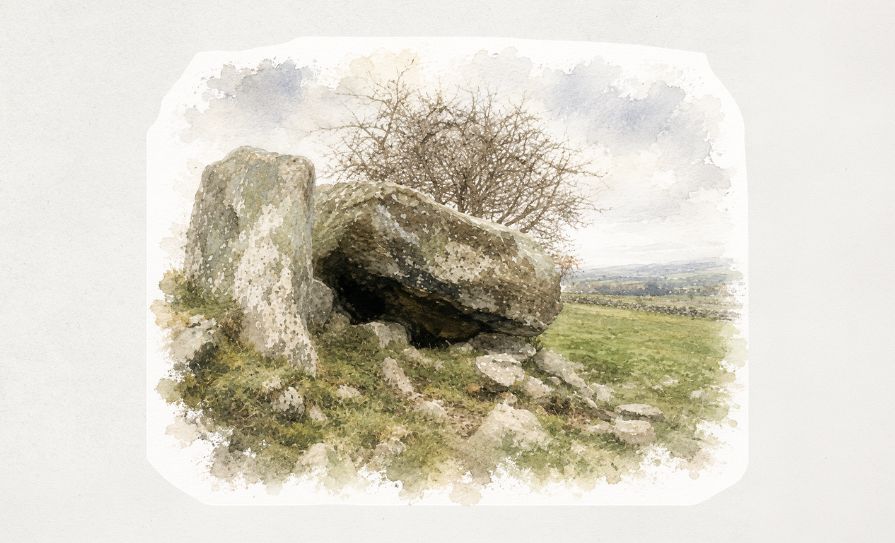
And there ahead of us, as I had remembered it, the stone encrusted mound that Mary Gallagher called the Todd’s Den; the Giant’s Grave. She once told me in her hushed tones that she had never went onto it, avoiding all contact as her mother-in-law had instructed when Mary first came to the farm as a young bride. A man from the Ministry, she confided, had once arrived to investigate, and in doing so broke a number of branches on one of the hawthorn trees. The next morning when he awoke, his hair was lying on the pillow.
We approached the mound gingerly, not wishing another bovine stampede. By this point, the cows had lost interest.
Neolithic Wedge Tomb
The Todd’s Den is a classic neolithic wedge tomb with portal stones facing west and narrowing over its 15 feet, and it seems few know of its existence. Not very impressive looking on this grey and wet Monday afternoon, if excavated, this 3,500-year-old structure would
be spectacular. Unlike my great-aunt Mary’s house of which there is no trace, it has rightly been protected; by being ignored, avoided, neglected and very likely feared. Two hawthorn trees still grow atop and we were careful not to touch any part, and left as we came.
Visiting the Giant’s Grave, we were of course guilty of trespass, probably from the moment we crossed the farm gate at the bottom of the lane, certainly from the point we opened the slap and entered the back-field. I had rehearsed a defense, should we be challenged. I was showing my son the home of his great-great-aunt and I hoped that connection, names from the recent past, would seal a common bond and exonerate us of any crime. Heaney’s Tollund Man, and his contemporaries from Irish bogs, were a clear and chilling warning not to commit trespass.
North-West archeology
The North-West is covered in archeological and historical treasures from the ancient past and more recent times. I am no historian, but have recently realised the joy of these historical artifacts literally at and under our feet.
Our first stop of that day was at the Grianán of Aileach in Co Donegal. From this 8th Century fort, reconstructed in the 1870s by an Anglican clergyman, the fort gives outstanding views; to the West up Lough Swilly and across Inch Island, to the North up the Innishowen Peninsula to the North-East over Lough Foyle, and to the South up along the Foyle towards Lifford and Strabane. This panoramic view is why this structure is here. It was home to the Cenél nEóghain (the Ui Neills) and was sacked by the Vikings.
Plantation of Ulster
From here we travelled South along minor side roads towards Lifford and snaked over and back between the two jurisdictions — the UK and Ireland — without even knowing. At Lifford, we visited St Lugadius’s Church (Church of
I remembered it as the back-field; today, home to 10 grazing cows
Ireland) just off the Diamond. This church was built in 1625 in the early years of the Plantation of Ulster and is still hosting weekly services. St Lugadius was a 6th Century Irish saint and missionary and contemporary of St Columba. He mostly worked in Scotland and is buried there, but came from this part of Ireland. Another version of his name is St Moluag, or Mulagh. St Patrick’s Catholic Church just outside Lifford is situated in Murlog.
From Lifford, we could have crossed the border again into Strabane at the head of the River Foyle, where the River Mourne and River Finn join in its formation, but we travelled on along the right bank of the River Finn to Castlefin on route to Castlederg. What I had not appreciated, having visited both towns many times, is their similarity. The physical shape of the towns, especially the Diamonds, are almost identical, as are the roads leading onto the bridges; one over the Finn, the other over the Derg a tributary of the Mourne. This architecture and town design clearly comes from the early years of the Plantation, but these were always important river crossing points and for that reason the castles, in both towns, predate the Plantation.
Our history is in the fabric and the names of the places where we live. Habitation leaves its mark and informs. Sadly, so much of historical fabric is removed, much of it necessarily, but what we can we should maintain.
Get out there and find it, cherish it and treat it with care and consideration. But be careful with trespass, and best stay away from the Todd’s Den or you might get stampeded by cows, your hair might fall out, or worse still — you might suffer a bout of mercury poisoning.
Terry Maguire owns two pharmacies in Belfast. He is an honorary senior lecturer at the School of Pharmacy, Queen’s University Belfast. His research interests include the contribution of community pharmacy to improving public health.