A skin consultation at the counter left Fintan Moore temporarily scratching his head
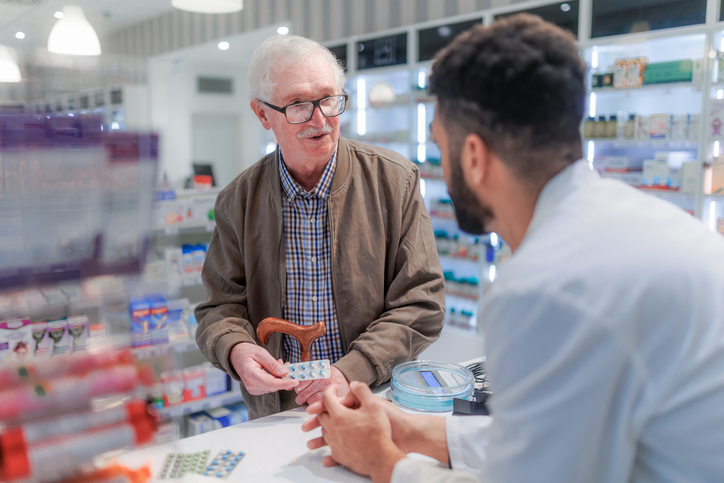
Even though pharmacists probably have a busier and more complicated workload now than at any time in the past, we are still the most instantly accessible professionals in the entire healthcare system. We are also free to talk to in the financial sense as well as free in the available sense, so naturally we are the first port of call for a huge chunk of the population.
Sometimes, people just need advice on whether a problem is possibly something serious that needs urgent medical attention, or is more benign and less critical. One thing we pharmacists definitely get to see a fair few of is rashes of many and varied patterns and colours (mostly pinks and reds), as patients look for an idea of what’s causing them.
Over the years I’ve memory-banked a good number of rashes and can take a reasonable guess at a diagnosis, but recently I had two different ones that left me stumped. The first was a purplish patchy rash on the backs of both hands of a man in his 50s. Apart from a small bit on his wrists, it didn’t appear on any other part of his body. I told him I was at a loss for an answer, but he was happy for me to send a WhatsApp photo into the Irish Pharmacist Support Group to see what the collective mind could offer.
Over the years I’ve memory-banked a good number of rashes and can take a reasonable guess at a diagnosis
Within five minutes, I had the answer, which was ‘Senile Purpura’, so-called because it’s more common in older people, and is purple. It’s also more likely in people on blood-thinners, which also matched with this guy. It’s caused by sun exposure and physical abrasion of the skin, and tends to settle after a few weeks, but tends to recur.
The other rash that left me at a loss was a case of Bullous Impetigo, which is the less-common form of Impetigo, and accounts for about 30 per cent of cases. Like us all, I’ve seen a lot of Impetigo, but hadn’t see the Bullous version before. Once again, a photo to the WhatsApp group yielded an identification almost instantly.
Social network working
The Pharmacist Support WhatsApp is clearly a very useful and incredibly efficient way to get answers to various problems, which makes sense when you crunch the numbers. I think there are 300 members in the group, so if the average member has 10 years’ working experience, then the combined membership has 3,000 years of community pharmacy under its belt, which means that between us all, there’s not much we haven’t seen. Even something niche that might only be seen once in a working lifetime will possibly ring a bell with one of the members. Having said that, at the end of some days I feel about 3,000 years old all by myself.
The other great benefit of having the group is the collegiate nature of it. Community pharmacy can be lonely and isolating for some pharmacists, depending on their working environment and support staff, so the availability of help and advice from well-intentioned professional colleagues is psychologically beneficial, in addition to the practical assistance on offer.
A lot of pharmacists are in a situation where they are the only one on duty and there are often times in a pharmacy when the right decision can be hard to identify. This is especially true when under the pressures of time and prescription volume, so being able to get other perspectives helps to ease the stress.
Working nice can work out nicely
In any line of work or in life generally, the maxim that ‘it costs nothing to be nice’ is usually good advice. Sometimes in business, it might cost nothing and also be really useful for generating extra custom.
I’d a good example of this recently during a weekend break in France. We’d flown in on an evening flight, so we only arrived in the small town (Sault in Provence — worth a visit) where we were staying about 9pm, when most restaurants were closing up. The owner of one of the restaurants was probably tired and at the end of a long day, but nevertheless spent about two minutes explaining where we could find a creperie that was still open.
We found the creperie and had a nice meal, but the following night we went to that restaurant because the owner had been helpful. There were five of us, hungry from a day’s cycling, and we spent about €300 on food and more drink than was wise. So the two minutes the guy spent the night before created the goodwill for a decent bit of business.
The same philosophy applies in community pharmacy, which ultimately is also retail pharmacy. A small bit of effort to help somebody with no apparent financial return can pay off down the line. Even if it doesn’t pay off in money, it still adds to the perception in the public mind that pharmacists are there to be helpful and trusted. That’s impossible to quantify, but is no bad thing.