This module synopsises the most common types of anxiety disorders. On completion of this module, it is expected the reader will have an enhanced understanding of the different types of anxiety disorders and how to identify them, as well as treatment strategies and the role of the pharmacist.
Introduction
Anxiety disorders are marked by persistent and excessive feelings of fear and anxiety, often accompanied by maladaptive behaviours aimed at reducing these unpleasant emotions.¹ Both fear and anxiety can cause physical symptoms such as nausea or sweating, as well as behavioural responses like anger or avoidance.
Fear represents an emotional, physical, and behavioural reaction to an immediate threat or danger, while anxiety reflects the anticipation of a future threat, whether real or imagined. Anxiety may persist even after the threat has passed or arise without any clear cause. Both anxiety and fear are actually adaptive and facilitate survival — in certain situations, adaptive anxiety is useful to motivate people to prepare, practice, and rehearse, or to avoid dangerous situations. However, clinical attention is required when fear and anxiety become disproportionate to the threat in terms of severity and persistence, or if they negatively impact day-to-day functioning.¹?²
This boundary between having an anxiety disorder and just experiencing normal anxiety are often not clearly defined, and the distinction between these requires clinical judgement that considers the severity, persistence, severity, and degree of distress/impairment.
Heritability estimates (the proportion of risk attributable to genetic variance) suggest that genetics account for 35-to-50 per cent of anxiety disorder risk; however, findings from genetic, genome-wide association and epigenetic studies have yet to yield results that can be meaningfully applied in clinical practice.² Environmental influences like stressful life experiences, childhood trauma, separation from attachment figures, and overprotective parenting can also contribute. There are unique combinations of genes and environmental factors that can increase anxiety disorder risk across the lifespan.
Different anxiety disorders are distinguished based on the specific objects or situations that give rise to the patient’s fear, anxiety, and behavioural changes. These disorders are more common than any other type of psychiatric disorder — up to a third of people meet the diagnostic criteria for an anxiety disorder at some stage in their lives, yet it is frequently underdiagnosed.
… up to a third of people meet the diagnostic criteria for an anxiety disorder at some stage in their lives
Researchers who conducted a survey³ examining anxiety disorders across 21 countries worldwide found that only about 28 per cent of people with the condition are treated, and of those who do receive treatment, only a third are estimated to receive adequate treatment.² Depression, substance use disorders, and personality disorders are common psychiatric comorbidities. Anxiety disorders often precede other psychiatric disorders, so it is important to diagnose and initiate early and effective treatment to help prevent their development.¹
Types of anxiety disorders
Acute stress disorder, adjustment disorders, and post-traumatic stress disorder (PTSD) often present with anxiety, but are considered separately as they are classed as a separate group of disorders that arise out of traumatic or stressful experiences. PTSD was classed as an anxiety disorder until recently, but is now included in Trauma and Stressor-Related Disorders in the DSM 5.¹
The diagnosis of an anxiety disorder requires the use of the WHO’s International Classification of Diseases or the American Psychiatric Association’s Diagnostic and Statistical Manual.? The most up-to-date Diagnostic and Statistical Manual of Mental Disorders (5th edition, Text Revision; DSM-5-TR) lists the various anxiety disorders in order of the typical age of onset:²
- Separation anxiety disorder.
- Selective mutism.
- Specific phobia (animal, natural environment, blood-injection injury, situational).
- Social anxiety disorder.
- Panic disorder.
- Agoraphobia.
- Generalised anxiety disorder.
- Substance-induced/medication-induced anxiety disorder.
- Anxiety due to another medical condition.
- Other specified anxiety disorder.
The first two anxiety disorders usually arise during childhood, with the rest presenting in adulthood. When an adult presents with significant anxiety, it is important to consider whether the cause may be related to any potential influence of any substance abuse, side-effects from other medication, and/or anxiety related to a medical condition.
This module will focus on the management of generalised anxiety disorder (GAD), panic disorder (PD), and social anxiety disorder (SAD). Although lifetime prevalence rates differ across studies, research from the US indicates that about 12 per cent of adults are affected specifically by SAD at some point, compared with approximately 6 per cent for GAD and 5 per cent for PD.
Generalised anxiety disorder (GAD)
GAD is characterised by excessive anxiety and worry about a broad range of situations and issues, rather than a specific event. According to NICE guidelines,? GAD assessment is based on the DSM, including the number and severity of symptoms, duration of episode, and general course of the anxiety disorder. The key symptoms of GAD are:
? Excessive anxiety and worry about a number of events or activities; and
? Difficulty controlling the worry.
For GAD diagnosis, the worry should persist on a majority of days for at least six months. If the two key symptoms are present, check for the following associated symptoms:
? Restlessness.
? Being easily fatigued.
? Difficulty concentrating.
? Irritability.
? Muscle tension.
? Disturbed sleep.
For management of GAD, a stepped care model is recommended – ie, offering the least intrusive intervention first (Step 1), and escalating as required (Table 1).
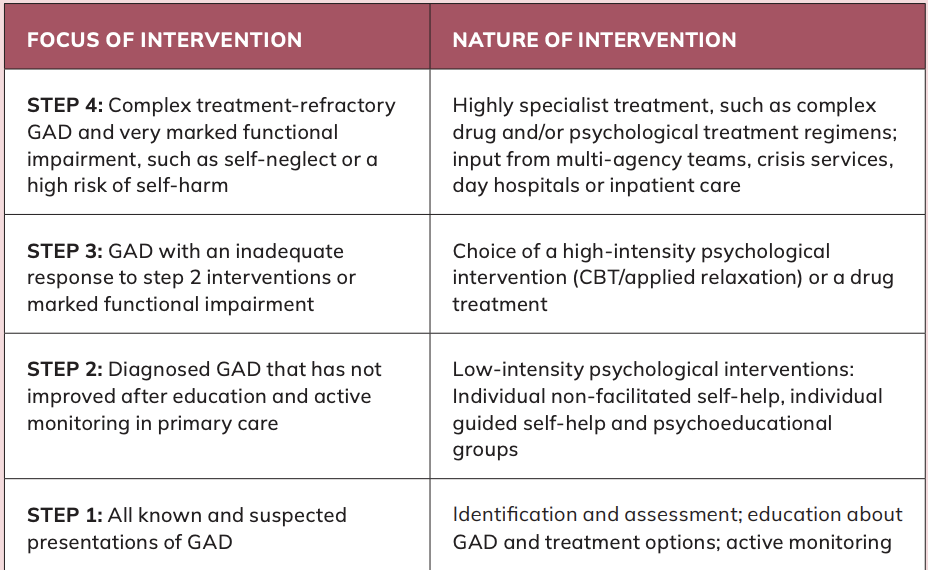
Step 1 interventions
? This step is appropriate for patients that experience mild or intermittent symptoms, have no past history of mood disorder, and where there is no interest in active treatment.
? Awareness of the potential presence of anxiety disorders is important, especially in those:
? With a previous history of anxiety disorders.
? Who have experienced a traumatic event recently.
? With chronic health problems.
? Without health problems seeking reassurance about somatic symptoms (ie, the physical sensations that accompany anxiety, such as racing heart, shortness of breath, nausea, muscle tension, and dizziness).
? The two-item GAD-2 scale (Table 2), which has good sensitivity and specificity for aiding with diagnosis of anxiety disorders in primary care, can be used to aid diagnosis.?
GAD score is obtained by adding the score for each question. A score of three points is the preferred cut-off for needing further evaluation.
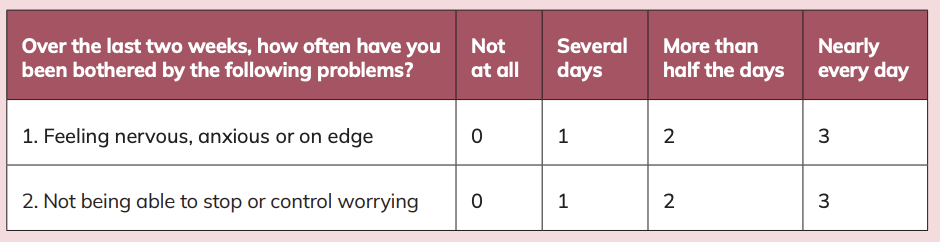
? Assessing the extent of distress and functional impairment is essential, in addition to:?
? The number, severity, and duration of symptoms.
? Impact of any other medical condition.
? Past treatments on current GAD symptoms.
? Education combined with active monitoring has been shown to improve mild presentations of GAD and prevent progression. After diagnosis, patients should receive appropriate information regarding their disorder and the available treatments, with continued assessment of symptoms and functioning.
Step 2 interventions
? This step is useful in individuals:
? With significant distress and impairment in functioning.
? With a comorbid mood disorder.
? Who have interest in pursuing active treatment for GAD.
? If symptoms have not improved with Step 1 interventions, alternative interventions can be offered:
? Individual non-facilitated self-help for people with GAD, which should include age-appropriate written/electronic materials, based on CBT principles, and worked through over about six weeks. Minimal therapist intervention (the occasional five-minute phone call) is required.
? Individual guided self-help for people with GAD, which is a similar programme, although it is delivered with the support of a trained practitioner.
? Psychoeducational groups, which should be based on CBT, be interactive, encourage observational learning, include presentations and self-help manuals, and be conducted by trained practitioners. These usually consist of six weekly sessions of two hours.
Step 3 interventions
? This step is useful for individuals who:
? Demonstrate marked functional impairment or distress.
? Demonstrate inadequate response to Step 2 interventions.
? Have a past history of mood/anxiety disorders.
? A choice of either high-intensity psychological intervention (CBT, applied relaxation) or pharmacological treatment should be offered.
? If drug treatment is chosen:
? An SSRI should be offered, with sertraline the first line choice.
? If sertraline is not tolerated or ineffective, an alternative SSRI or SNRI (such as venlafaxine, which is licensed for GAD) should be offered, taking into account individual patient history and preference.
? If neither SSRIs or SNRIs are tolerated, pregabalin may be considered. Benzodiazepines should not be offered except during a crisis for short-term use only. Antipsychotics should not be offered in a primary care setting for anxiety.
? Provide the patient with appropriate information on the likely benefits of the different types of treatments, including benefits and drawbacks.
? If the GAD has not responded to a full course of high-intensity psychological intervention, drug treatment should be offered, and vice versa.
Step 4 interventions
? Step 4 interventions are advised if the person with GAD:
? Has an inadequate response to previous interventions.
? Is at risk of self-harm.
? Has a comorbidity such as substance abuse, multiple psychiatric comorbidities, personality disorder, severe functional impairment, or self-neglect.
? Specialist assessment — including, eg, symptoms, impairment, risk to self, review of past treatments, adherence, home environment, support, and relationships — should be offered. This review should be used to formulate a treatment plan.
? Any treatments from the earlier steps that have not yet been tried may be considered. A combination of antidepressants may be tried, although there is no strong research evidence to demonstrate the efficacy of this, and there is an increased risk of side-effects. Combining treatments should be done only under the supervision of clinicians experienced in doing so.
Panic disorder (PD)
PD is an anxiety disorder involving repeated and sudden episodes of overwhelming fear or panic. NICE guidelines? provide recommendations for different steps of PD management, depending on the stage of treatment:
Step 1: Recognition and diagnosis
? A structured approach should be adopted for the diagnosis and management of PD. Accurate diagnosis is essential, as comorbid conditions such as depression or substance misuse may complicate the clinical picture. Currently, there is no evidence to support the use of a specific screening instrument for diagnosing PD — therefore, the process relies heavily on clinical consultation skills to gather all relevant information.
? To determine the priorities of any comorbidities, if present, creating a timeline to summarise when the symptoms or problems developed can be useful.
Step 2: Treatment in primary care
? Psychological therapy, medication, and self-help strategies can all be effective in treating anxiety disorders.
? Individual non-facilitated self-help or individual facilitated self-help can be offered to people with low or moderate PD.
Step 3: Review and consideration of alternative treatments
? In moderate-to-severe cases, referral to CBT or the initiation of an antidepressant (not sedating antihistamines or antipsychotics) are options.
? SSRIs, SNRIs, and TCAs have all demonstrated efficacy in PD.
? Individual factors should guide treatment choice, such as age, previous treatment response, likelihood of overdose, tolerability, interactions, and patient preference.
? If after 12 weeks of SSRI treatment there is no improvement, alternative options include imipramine or clomipramine.
? If an improvement in symptoms is observed, treatment should be continued for at least six months after the optimal dose has been initiated.
Step 4: Review and referral to specialist mental health services
? If two interventions have already been used and the person still has significant symptoms, referral to specialist medical services is advised.
Step 5: Care in specialist mental health services
? A thorough reassessment, including previous treatment and concordance, substance use, comorbidities, functioning, social networks, and stressors should be undertaken and used to form the new management plan.
? If a new medication is commenced, a review after two weeks initially, then at four, six and 12 weeks should evaluate the efficacy and side-effects.
? Self-completed questionnaires (like the panic subscale of the agoraphobia mobility inventory for individuals with PD) can be used to monitor symptoms and outcomes.
Social anxiety disorder (SAD)
SAD is persistent fear of or anxiety about one or more social or performance situations that is out of proportion to the actual threat posed by the situation.? People with social anxiety disorder fear behaving in ways they believe will embarrass them, such as appearing nervous or incompetent.
The condition can significantly affect daily functioning, relationships, quality of life, and performance at work or school. It has a mean onset at around the age of 13 and can be very persistent. Some individuals may turn to alcohol or drugs to cope with their anxiety or low mood.
People with SAD may be unaware that their condition is treatable and may view it as a personal weakness. They can be especially sensitive to stigma, often avoiding interactions with healthcare professionals or others. As a result, they may struggle to share information, engage in discussions, or concentrate during consultations. When an appointment for someone with social anxiety disorder is offered — especially in specialist settings — it may make it less stressful if clear written information about what to expect is given, including where to go, available facilities, and details of the assessment or treatment process.
People with SAD may be unaware that their condition is treatable and may view it as a personal weakness
If social anxiety is suspected, the 3-item Mini-Social Phobia Inventory (Mini-SPIN) can be used for assessment (Table 3). The individual should be assessed for social anxiety disorder with a score of six or higher.
Alternatively, two questions can be asked:
? Do you find yourself avoiding social situations or activities?
? Are you fearful or embarrassed in social situations?
If the person answers ‘yes’ to either of these, they should be assessed for SAD.? Initial treatment for SAD includes individual, tailored CBT. CBT-based supported self-help can be offered to people who do not wish to attend individual CBT. If the person wants to opt for pharmacological treatment, the reasons for declining CBT-based interventions should be discussed, and concerns addressed. If the pharmacological route is still preferred, an SSRI (escitalopram or sertraline) is recommended as first-line treatment.
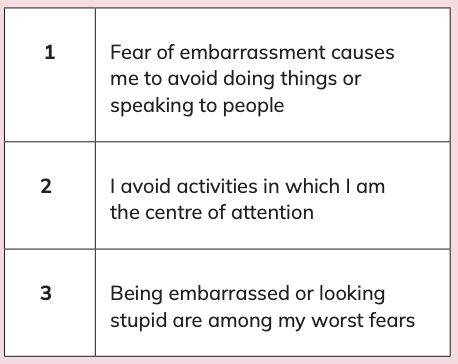
*The items are rated using a five-point scale: 0 = not at all, 1 = a little bit, 2 = somewhat, 3 = very much, 4 = extremely.
Scores of 6 or higher indicate possible problems with social anxiety.
The individual should be carefully monitored for adverse reactions, and educated about the likely benefits, possible side-effects (eg, risk of increased anxiety, jitteriness, problems sleeping, with early use of SSRIs and SNRIs), gradual development of the anxiolytic effects, importance of compliance, and possible withdrawal/discontinuation symptoms.
Treatment considerations
Comparing RCTs that assess medication or psychological therapies for anxiety is difficult, as differences in control conditions — such as sham, placebo, or waiting-list controls — and the potential impact of placebo effects complicate interpretation.² Potential side-effects and treatment availability should be considered when creating a shared management plan with the patient. Regardless of the chosen approach, the treatment should be made available without delay.?
Psychotherapy treatment considerations:
? Not all forms of psychotherapy are effective: The strongest evidence is in favour of CBT, using techniques such as exposure or cognitive restructuring.
? Similar effectiveness has been reported for internet- or screen-based CBT compared with face-to-face, although there is less evidence available for its effectiveness in children.
? Meta analyses of CBT on anxiety have observed a trend of the effects being large when the control is waiting list placement, but small-to-moderate when the control is care-as-usual or placebo.
Pharmacotherapy treatment considerations:
? In general, all SSRIs, SNRIs, and clomipramine are superior to placebo in reducing anxiety symptoms in adults, although licensing approval varies from drug-to-drug and country-to-country. A network meta-analysis of GAD treatments favoured duloxetine, venlafaxine, escitalopram, pregabalin, and quetiapine, but there was a higher discontinuation rate with quetiapine.²
? With no clear superiority shown of any SSRI or SNRI, medication choice should be based on side-effect profile and potential interactions, if relevant. A 2022 review published in JAMA found that the risk-benefit ratio appears better for newer medications, including venlafaxine, escitalopram, and sertraline.
? Benzodiazepines are acutely effective in anxiety disorders, but lead to relapse on discontinuation, and dependence, so their use needs strict monitoring.
? The initial disease severity impacts the effect size of the drug treatment in both GAD and PD, with greater effects in severe disorders compared to mild.
? It is important that patients are informed of the two-four week latency of effect.²
? Everyone starting on antidepressants should be informed of the potential side-effects, including risk of transient increase in anxiety, and the potential discontinuation/withdrawal symptoms if stopped or missed.?
? To minimise side-effects, therapy should be initiated at a low dose and titrated gradually until there is a response.²
? Patients with anxiety tend to exhibit heightened sensitivity to adverse medication effects.
? Evidence from placebo-controlled trials supports continuing treatment for a minimum of 12 months following response, given that placebo-controlled studies have shown an increased risk of relapse on discontinuation. By comparison, NICE guidance recommends at least six months of treatment.
? Combination treatments are used by many people in cases of treatment resistance and comorbidity, but available research evidence shows that combined pharmacological and psychological treatments are superior to pharmacotherapy alone.?
? When discontinuing medication, reduce gradually over several weeks to reduce discontinuation/withdrawal symptoms (ie, dizziness, numbness, tingling, gastrointestinal disturbances, headache, sweating, anxiety, sleep disturbances). If these symptoms are severe, it may be useful to reintroduce the antidepressant (or another within the same class with a longer half-life) and reduce the dose gradually while monitoring symptoms.?
? Substance use can be a complication of anxiety disorders. If the patient is using cocaine, there is a risk that concurrent use of SSRIs may cause hypertension and increase risk of bleeding.?
? Patients under 30 should be seen again within a week or two of first prescribing SSRIs/SNRIs, and monitored for the first month for any signs of self-harm and suicidal thinking.
Patient care
It is important to be mindful that stigma and discrimination are often associated with using mental health services. Service users should be treated with respect, sensitivity, warmth, and empathy.? People have the right to be involved with discussions and make informed decisions about their care, which empowers them to make decisions appropriate for them.?
Non or partial adherence to taking medicines is common, both intentional (eg, due to patient decisions, beliefs, risk/benefit balancing) and unintentional (practical barriers, forgetfulness, complexity).
Practical actions to take to improve adherence include:¹?
? Shared decision-making: Discuss the condition and treatment options with the patient, finding out how much involvement the patient wants in decisions. If a patient with capacity chooses not to take a medicine after being given the appropriate information, respect and record their decision.
? When dispensing medication, check if the patient has the information they need. Instead of just handing out PILs, confirm their understanding — including how to use it, benefits, side-effects, missing a dose, and how to get their next supply.
? Adherence should be assessed in a non-judgmental way when medicines are being dispensed, using the PMR as an indicator of adherence.
? Provide support for adherence where possible. Discuss reasons for non-adherence, and offer practical solutions such as alternative packaging and suggestions for reminders.
? Good communication between all healthcare professionals involved in care is important to ensure consistent support and advice. Where necessary, the prescriber should be contacted where there have been discussions about adherence issues.
Role of the pharmacist
Anxiety disorders are highly prevalent yet under-diagnosed, often presenting with excessive fear, worry, and physical symptoms. Pharmacists play a key role in recognising symptoms, supporting adherence, and guiding stepped-care management.
For anxiety disorders, interventions range from education and self-help to CBT and pharmacotherapy with SSRIs or SNRIs. Pharmacists should ensure patients receive clear, evidence-based information, understand treatment expectations, and feel supported in shared decision-making to promote adherence in a stigma-free environment.
True/False questions
Q1. Both anxiety and fear are actually adaptive and facilitate survival. In certain situations, adaptive anxiety is useful to motivate people to prepare, practice, and rehearse, or to avoid dangerous situations.
True / False
Q2. Heritability estimates (the proportion of risk attributable to genetic variance) suggest that genetics account for 80 per cent of anxiety disorder risk.
True / False
Q3. Up to 20 per cent of people meet the diagnostic criteria for an anxiety disorder at some stage in their lives.
True / False
Q4. Anxiety disorders often precede other psychiatric disorders, so it is important to diagnose and initiate early and effective treatment to help prevent their development.
True / False
Q5. For management of GAD, a stepped care model is recommended — ie, offering the least intrusive intervention first (Step 1), and escalating as required.
True / False
Q6. If pharmacological treatment is initiated for GAD, pregabalin should be tried first.
True / False
Q7. Benzodiazepines should not be offered except during a crisis for short-term use only.
True / False
Q8. A combination of antidepressants may be tried in GAD management because there is strong research evidence to demonstrate the efficacy of this.
True / False
Q9. There is evidence to support the use of screening instruments for diagnosing GAD, PD, and SAD.
True / False
Q10. Studies comparing RCTs that assess medication or psychological therapies for treating anxiety have shown that medication is more effective than psychological therapies.
True / False
Author: Dr Donna Cosgrove PhD. Donna’s overall aim is to improve patient outcomes through education. After graduating with a BSc in Pharmacy, she returned to university to complete a MSc in Neuropharmacology. This led to a PhD investigating the genetics of schizophrenia, followed by a postdoctoral research position in the same area. She has worked in hospital, research and community pharmacy settings and is currently a community pharmacist in Galway and a clinical writer.
COMPLETE THIS MODULE ONLINE
You can check your answers to the T/F and MCQ questions on PharmacistCPD.ie.
Successful completion of this module will earn you 2 CPD points.
References
- Barnhill J (2024). Overview of Anxiety Disorders. Available at: www.msdmanuals.com/professional/psychiatric-disorders/anxiety-and-stressor-related-disorders/overview-of-anxiety-disorders.
- Szuhany KL & Simon NM (2022). Anxiety disorders: A review. JAMA, 328(24), 2431-2445. Available at: pmc.ncbi.nlm.nih.gov/articles/PMC9248771/.
- Alonso J, Liu Z, Evans-Lacko S, et al, and WHO World Mental Health Survey Collaborators (2018). Treatment gap for anxiety disorders is global: Results of the World Mental Health Surveys in 21 countries. Depression and Anxiety, 35(3), 195-208.
- World Health Organisation (2025). Anxiety Disorders. Available https://www.who.int/news-room/fact-sheets/detail/anxiety-disorders.
- National Institute for Health and Care Excellence (2020). Generalised anxiety disorder and panic disorder in adults: Management [CG113]. Available at: www.nice.org.uk/guidance/cg113/resources/generalised-anxiety-disorder-and-panic-disorder-in-adults-management-pdf-35109387756997.
- Sapra A, Bhandari P, Sharma S, et al (2020). Using generalised anxiety disorder-2 (GAD-2) and GAD-7 in a primary care setting. Cureus, 12(5).
- National Institute for Health and Care Excellence (2013). Social anxiety disorder: Recognition, assessment, and treatment [CG159]. Available at: www.nice.org.uk/guidance/cg159/resources/social-anxiety-disorder-recognition-assessment-and-treatment-pdf-35109639699397.
- Connor KM, Kobak KA, Churchill LE, et al (2001). Mini-SPIN: A brief screening assessment for generalised social anxiety disorder. Depression and Anxiety, 14(2), 137-140.
- National Institute for Health and Care Excellence (2011). Service user experience in adult mental health: Improving the experience of care for people using adult NHS mental health services: CG 136. Available at: www.nice.org.uk/guidance/cg136/resources/service-user-experience-in-adult-mental-health-improving-the-experience-of-care-for-people-using-adult-nhs-mental-health-services-pdf-35109513728197.
- National Institute for Health and Care Excellence (2009). Medicines adherence: Involving patients in decisions about prescribed medicines and supporting adherence: CG 76. Available at: www.nice.org.uk/guidance/cg76/resources/medicines-adherence-involving-patients-in-decisions-about-prescribed-medicines-and-supporting-adherence-pdf-975631782085.
- An organisation- and category-level comparison of diagnostic requirements for mental disorders in ICD-11 and DSM-5. Available at: pmc.ncbi.nlm.nih.gov/articles/PMC7801846/.